Chandrashekhar Chowk: Memorial of Begusarai's First Communist MLA
The village square honouring a key figure in the 'Leningrad of Bihar' movement
Narrated in English (Browser TTS)
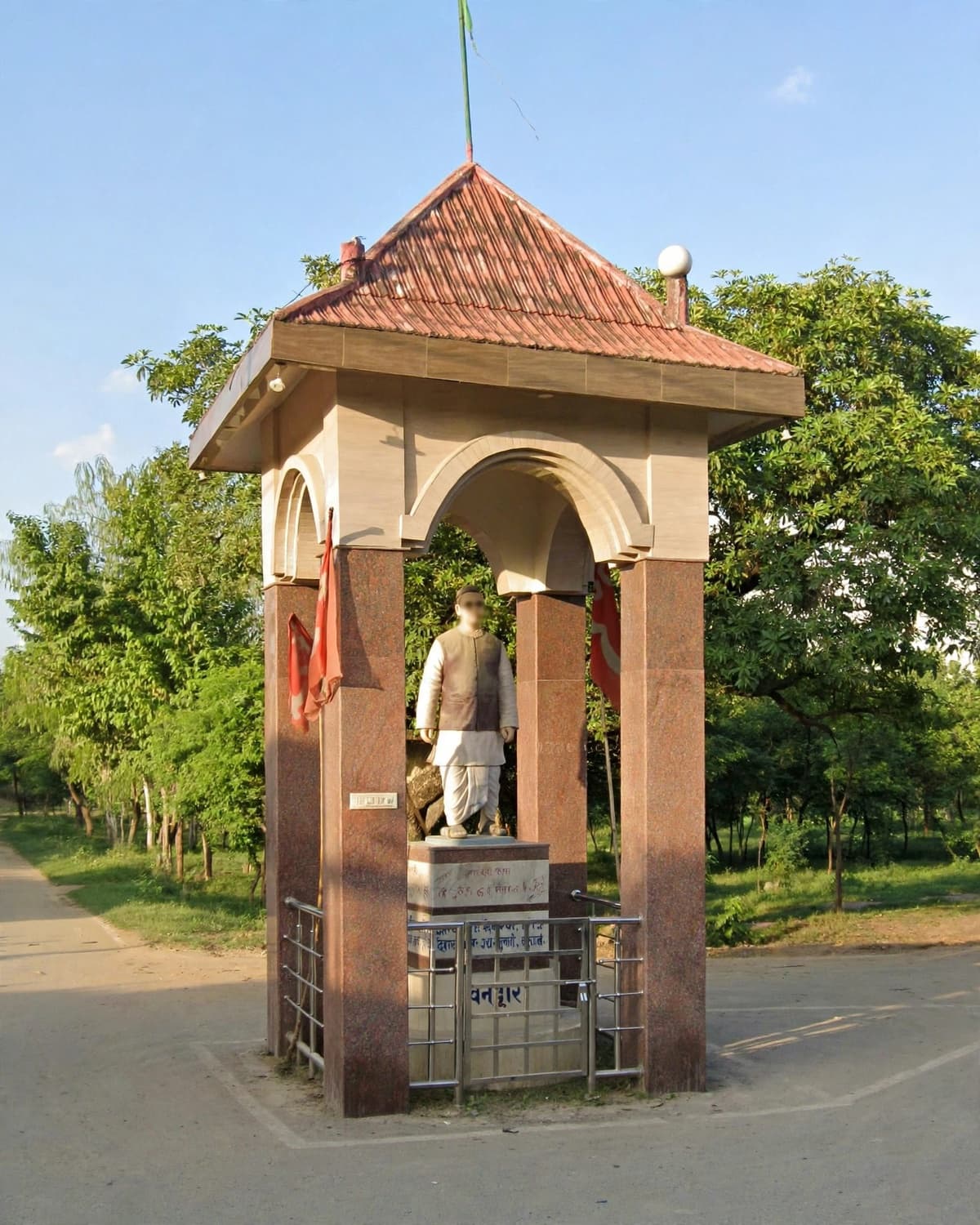
A village square in Bandwar with a statue of Chandrashekhar Singh — the first communist MLA from Barauni, and a defining figure in Begusarai's identity as 'the Leningrad of Bihar'. The chowk sits at a crossroads in the village centre, and its statue — under a canopy supported by red stone pillars — has become one of the most photographed features of Bandwar.
Overview
Who Was Chandrashekhar Singh
The Memorial
Significance
Present Day
Frequently Asked Questions
Who was Chandrashekhar Singh?
Why is 'Leningrad of Bihar' associated with Begusarai?
Why is there a statue of Chandrashekhar Singh in Bandwar?
Where is Chandrashekhar Chowk located?
Read Next
Shaheed Ramchandra Dwar (Martyrs' Gate), Bandwar
The main entrance gate to Bandwar village, named in memory of Ramchandra ji — a martyr from the village. Built under the initiative of Girija Singh, a resident of Bandwar, the gate stands at the point where the road from Begusarai enters the village. It is inscribed on both sides with 'Jai Hind' and 'Bharat Mata', and has become one of the most recognisable structures in Bandwar.
Shivala: The Historic Shiva Temple of Bandwar
Shivala is the village's Shiva temple, standing in the centre of Bandwar, Begusarai, Bihar. It is one of the village's eight temples and has served as a place of worship for generations. Built entirely by village residents, without any government support, it stands in a grove of trees near the [[historic-well-chaupal-bandwar|historic well]] that anchors the village centre.
Historic Well (Chaupal) of Bandwar: The Village Gathering Place
Bandwar's historic well has served as both a source of water and a gathering place — a chaupal — for generations. It was the subject of a feature in Prabhat Khabar in July 2026, which described it as 'still the centre of social dialogue and intellectual discussion in the village'. It sits near [[shivala-temple-bandwar|Shivala]] and the [[chandrashekhar-chowk-bandwar|Chandrashekhar Chowk]], and has been a centre of village life for as long as anyone remembers.
Bhagwandutt S.N.K. High School, Bandwar
Established in 1942 by Pandit Taradutt Pathak, S.N.K. High School is the oldest educational institution in Bandwar, Begusarai. Originally a free Sanskrit gurukul, it now operates as a government secondary school (Classes 9-10) with UDISE code 10201013302.
The Bandh: Bandwar's Historic Flood Protection Embankment
The bandh is the embankment built along the Burhi Gandak to protect Bandwar from floods. It is widely believed that the village takes its name from this very structure — 'Bandh' becoming 'Bandwar'. It runs parallel to the [[burhi-gandak-river-bandwar|Burhi Gandak]] along the western edge of the village, and is the single most important piece of infrastructure in Bandwar.
Burhi Gandak River: Bandwar's Lifeline and Adversary
The Burhi Gandak is a flood-prone river that flows along the western edge of Bandwar, in Begusarai district, Bihar. Situated in the fertile Indo-Gangetic plain, it is the largest tributary of the Ganga in the region. Its annual floods shaped the village's geography, its agriculture, and — most importantly — its name. The embankment built along the river, the [[bandh-embankment-bandwar|bandh]], is widely believed to be the source of the village's name: Bandwar.
Mentioned In
- Maharishi Gautam Aadi Shakti Durga Mandir, Bandwar
- The Bandwar Haat: Inside the Village Market Economy
- Shri Adi Durga Sthan (Durga Mandir): The Main Durga Temple of Bandwar
- Shaheed Ramchandra Dwar (Martyrs' Gate), Bandwar
- Historic Well (Chaupal) of Bandwar: The Village Gathering Place
- Baba Bhole Durgasthan Hanuman Mandir: Multi-Deity Temple of Bandwar
- Shivala: The Historic Shiva Temple of Bandwar