Bandwar Village Archive

Baba Bhole Durgasthan Hanuman Mandir: Multi-Deity Temple of Bandwar

A unique temple dedicated to Shiva, Durga, and Hanuman together
Updated on 2026-02-16
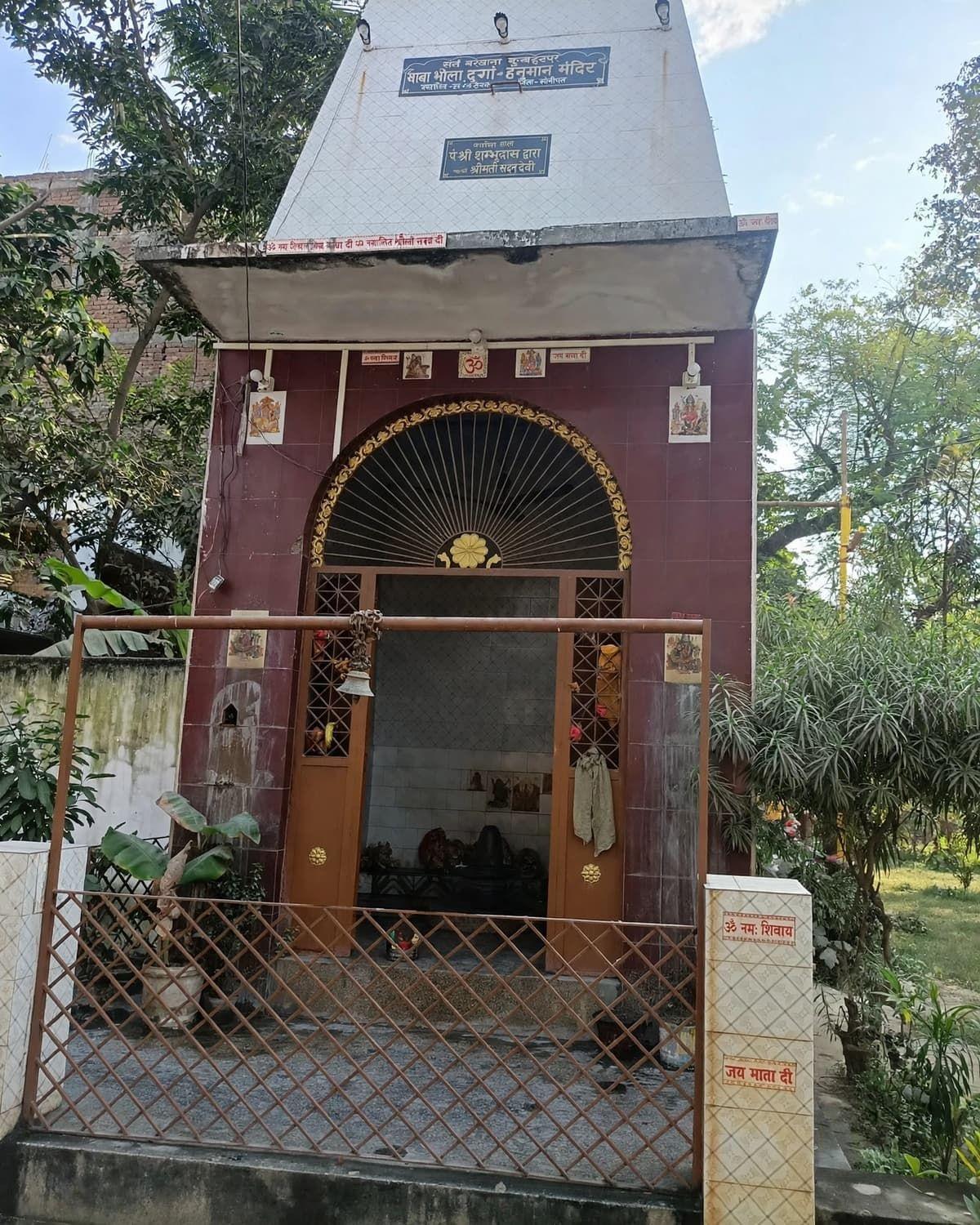
Baba Bhole Durgasthan Hanuman Mandir — the temple's maroon walls and blue-grey shikhara.
View Full Size
Listen to this article

Narrated in English (Browser TTS)

A temple in the centre of Bandwar dedicated to three deities — Baba Bhole (Shiva), Durga, and Hanuman. It is distinguished by its blue-grey shikhara, maroon walls, and an iron gate inscribed with 'Om Namah Shivaya'. It is one of the eight temples clustered in the village centre.

Overview

The Baba Bhole Durgasthan Hanuman Mandir stands in the middle of Bandwar, and is one of the few temples in the village dedicated to more than one deity. Its name — Baba Bhole, Durgasthan, and Hanuman — reflects its triple dedication to Shiva, Durga, and Hanuman. It is, in effect, three temples in one — a fact reflected in the village's habit of referring to it by all three names in a single breath. The temple sits between the two Krishna Mandirs and the Hanuman Mandir, and completes the dense cluster of shrines that make up the village's religious centre.

Architecture

The temple is built with a blue-grey shikhara above a maroon-walled sanctum. An arched doorway, framed with an intricate golden screen, opens into the shrine. The entrance gate is made of iron, and carries the inscription 'Om Namah Shivaya' alongside images of Hindu deities. The combination of colours — blue-grey, maroon, and gold — gives the temple a distinctive appearance among Bandwar's mostly whitewashed shrines, and it is often cited by visitors as one of the most striking small temples in the village.

The Deities

Inside the sanctum, idols of the three deities are arranged together. The temple's name suggests that Baba Bhole — Shiva — occupies the central position, with Durga and Hanuman to either side. This triple enshrinement is unusual for a village temple of this size, and reflects the collective nature of the shrine's construction: different families in the village contributed to the installation of each idol, and the temple was conceived from the outset as a shared sacred space.

Festivals

The temple observes three festivals — Maha Shivaratri for Shiva, Chaitra Navratri for Durga, and Hanuman Jayanti for Hanuman. On these days, the temple is decorated and receives a large number of worshippers. It is one of the few temples in Bandwar to observe all three of the village's major religious festivals, and its calendar therefore overlaps with those of Shivala, Maharishi Gautam Durga Mandir, and Hanuman Mandir.

Present Day

The temple is looked after by the village community and remains in active use throughout the year. It sits near the historic well and Chandrashekhar Chowk, and is a common stop on the informal circuit of shrines that villagers make on festival days. In the evenings, the temple's blue-grey shikhara is visible from the lane that runs past it, and the sound of bells from its doorway often carries into the surrounding lanes.

Frequently Asked Questions

Which deities are worshipped at Baba Bhole Durgasthan Hanuman Mandir?
The temple is dedicated to three deities — Baba Bhole (Shiva), Durga, and Hanuman — and is one of the few multi-deity temples in Bandwar. The three idols are arranged together in the sanctum.
Why does the temple have three names?
The name 'Baba Bhole Durgasthan Hanuman Mandir' reflects the temple's triple dedication. 'Baba Bhole' refers to Shiva, 'Durgasthan' to Durga, and 'Hanuman' to Hanuman ji. The village refers to the temple by all three names together.
What festivals are celebrated at this temple?
Three major festivals — Maha Shivaratri for Shiva, Chaitra Navratri for Durga, and Hanuman Jayanti for Hanuman. On these days, the temple is decorated and receives a large number of worshippers.
What is inscribed on the temple's gate?
The iron entrance gate carries the inscription 'Om Namah Shivaya' — the five-syllable mantra dedicated to Shiva — alongside images of Hindu deities. The gate is one of the temple's distinctive features.

Read Next

Shivala: The Historic Shiva Temple of Bandwar

Shivala is the village's Shiva temple, standing in the centre of Bandwar, Begusarai, Bihar. It is one of the village's eight temples and has served as a place of worship for generations. Built entirely by village residents, without any government support, it stands in a grove of trees near the [[historic-well-chaupal-bandwar|historic well]] that anchors the village centre.

Sankat Mochan Hanuman Mandir: The Hanuman Temple of Bandwar

A temple dedicated to Hanuman ji, known for its bright red idol holding a gada (mace). The temple is small but well-maintained, with a brass bell hung at the entrance. It is one of the eight temples clustered in the centre of Bandwar, and among the most visited.

Maharishi Gautam Aadi Shakti Durga Mandir, Bandwar

A Hindu temple in Bandwar dedicated to Durga, with a distinctive orange exterior and green pillars. The temple houses a Chaiti Durga idol and is the site of the village's Chaitra Navratri celebrations. It is Bandwar's Chaiti Durga temple, while the village's other Durga temple, [[durga-mandir-bandwar|Shri Adi Durga Sthan]], serves the autumn Navratri.

Ram Mandir Thakurbari: The Twin-Shikhara Temple of Bandwar

Bandwar's Ram temple, distinguished by its twin shikharas, is one of the most recognisable structures in the village. It is the site of the annual [[ram-katha-thakurbari-bandwar-2021|Ram Katha]] — the recitation of the Ramcharitmanas — and is especially striking against the evening sky at sunset.

Bada Krishna Mandir: The Larger Krishna Temple of Bandwar

The larger of Bandwar's two Krishna temples, Bada Krishna Mandir houses a Radha-Krishna idol and is a whitewashed building with an arched entrance and a handpump in its courtyard. It is closely associated with the village's [[janmashtami-mela-bandwar-bihar|Janmashtami Mela]], the 200-year-old fair held annually on Krishna's birth.

Historic Well (Chaupal) of Bandwar: The Village Gathering Place

Bandwar's historic well has served as both a source of water and a gathering place — a chaupal — for generations. It was the subject of a feature in Prabhat Khabar in July 2026, which described it as 'still the centre of social dialogue and intellectual discussion in the village'. It sits near [[shivala-temple-bandwar|Shivala]] and the [[chandrashekhar-chowk-bandwar|Chandrashekhar Chowk]], and has been a centre of village life for as long as anyone remembers.

Something is incorrect?

If you have additional details, let us know.

Suggest an Edit
Last updated: 2026-02-16Source: Bandwar Village Archive