Bandwar Village Archive

Maharishi Gautam Aadi Shakti Durga Mandir, Bandwar

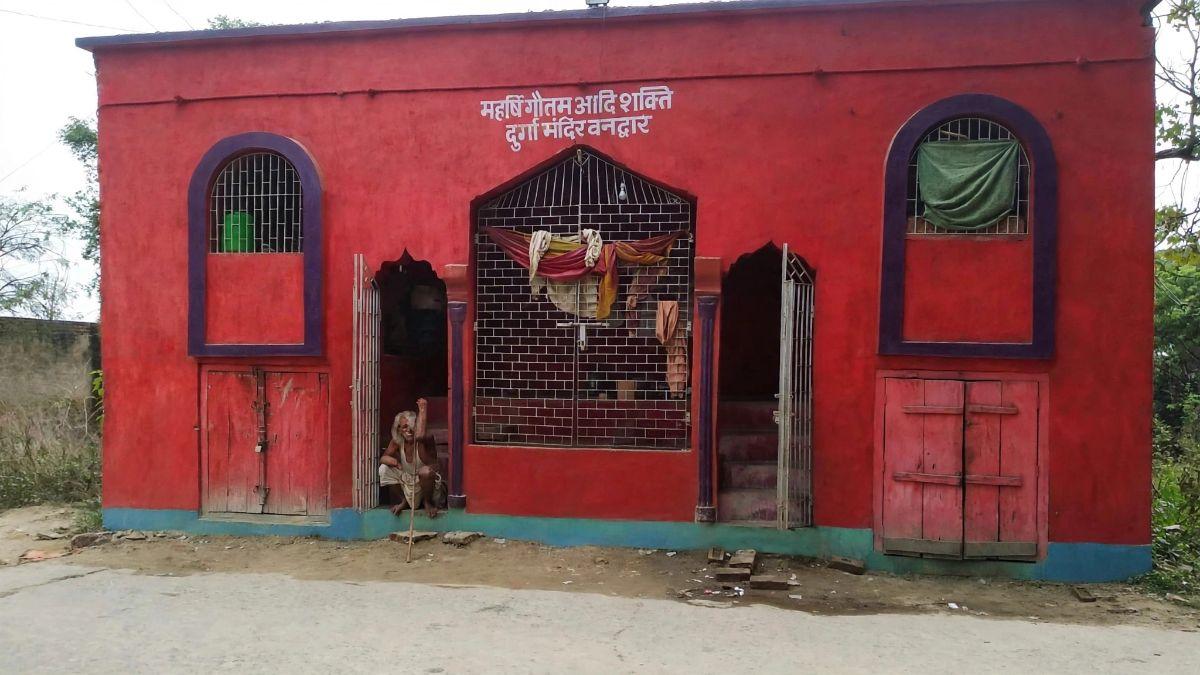
The village's Chaiti Durga temple, known for its orange exterior
Verified by Bandwar Editor
| 2026-11-17
Maharishi Gautam Aadi Shakti Durga Mandir decorated for the festival.
View Full Size
Listen to this article

Narrated in English (Browser TTS)

A Hindu temple in Bandwar dedicated to Durga, with a distinctive orange exterior and green pillars. The temple houses a Chaiti Durga idol and is the site of the village's Chaitra Navratri celebrations. It is Bandwar's Chaiti Durga temple, while the village's other Durga temple, [[durga-mandir-bandwar|Shri Adi Durga Sthan]], serves the autumn Navratri.

Overview

The Maharishi Gautam Aadi Shakti Durga Mandir is one of the village's most visited temples. It stands in the centre of Bandwar, painted in a distinctive orange with bright green pillars, and is easily recognisable from the lane that passes it. It is Bandwar's Chaiti Durga temple, while the village's other Durga temple, Shri Adi Durga Sthan, serves the autumn Navratri — making it, along with Ram Mandir Thakurbari and the two Krishna Mandirs, one of the anchors of the village's religious calendar.

The Deity

The temple is dedicated to Durga, in her aspect as Chaiti Durga — the form worshipped during Chaitra Navratri, which falls in March or April. The idol inside depicts the ten-armed Durga seated on a lion, engaged in combat with Mahishasura, the buffalo demon. She is flanked by her family — Lakshmi, Saraswati, Ganesh, and Kartikeya. The Chaiti aspect is distinguished from the more widely-known Shardi (autumn) Durga Puja celebrated in Bengal and across North India — Chaiti Durga is worshipped in spring, and is especially popular in Bihar and eastern Uttar Pradesh.

Festivals

Chaitra Navratri is the most important festival at this temple, when the village observes nine nights of prayer. During the festival, the temple is decorated with lights, and the doors are kept open for darshan through the day and into the night. Each of the nine nights is associated with a different form of Durga — Shailaputri, Brahmacharini, Chandraghanta, Kushmanda, Skandamata, Katyayani, Kalaratri, Mahagauri, and Siddhidatri. The festival concludes on Ram Navami, which is also celebrated at Ram Mandir Thakurbari.

Architecture

The temple has a simple, functional design — a rectangular hall with an arched entryway, iron grilles across the windows, and a small shrine at the centre. Above the doorway, the temple's name is painted in Hindi. The orange-and-green colour scheme makes the temple stand out from the whitewashed exteriors of Shivala and Bada Krishna Mandir, and it has become one of the most photographed structures in the village centre.

Present Day

The temple continues to be maintained by villagers. A woman from the village is often seen sitting outside the temple in the mornings, and the temple remains a common stopping point for anyone walking through the centre of Bandwar. Its proximity to Chandrashekhar Chowk and the historic well makes it part of the same walk through the village's religious and social core.

Frequently Asked Questions

What is Chaiti Durga?
Chaiti Durga is the form of the goddess Durga worshipped during Chaitra Navratri, which falls in March or April — as distinct from the Shardi (autumn) Durga Puja celebrated in Bengal and across North India. Chaiti Durga is especially popular in Bihar and eastern Uttar Pradesh.
What does the Durga idol at this temple depict?
The idol depicts the ten-armed Durga seated on a lion, engaged in combat with Mahishasura, the buffalo demon. She is flanked by her family — Lakshmi, Saraswati, Ganesh, and Kartikeya.
When is Chaitra Navratri celebrated at this temple?
Chaitra Navratri is celebrated over nine nights in March or April, culminating on Ram Navami. During the festival, the temple is decorated with lights, and the doors are kept open for darshan day and night.
Why is the temple painted orange and green?
The orange exterior with green pillars gives the temple its distinctive appearance, and helps distinguish it from the whitewashed exteriors of Shivala and Bada Krishna Mandir. The colour scheme has become one of the most recognisable features of the village centre.

Read Next

Shri Adi Durga Sthan (Durga Mandir): The Main Durga Temple of Bandwar

Shri Adi Durga Sthan, locally known as Durga Mandir, is the village's principal temple dedicated to Goddess Durga. It is distinct from the [[maharishi-gautam-durga-mandir-bandwar|Maharishi Gautam Aadi Shakti Durga Mandir]], which serves the springtime Chaiti Durga Puja. With its pale green exterior and an ornate iron gate, this temple is the centre of Bandwar's Sharadiya (autumn) Navratri and Durga Puja celebrations.

Ram Mandir Thakurbari: The Twin-Shikhara Temple of Bandwar

Bandwar's Ram temple, distinguished by its twin shikharas, is one of the most recognisable structures in the village. It is the site of the annual [[ram-katha-thakurbari-bandwar-2021|Ram Katha]] — the recitation of the Ramcharitmanas — and is especially striking against the evening sky at sunset.

Bada Krishna Mandir: The Larger Krishna Temple of Bandwar

The larger of Bandwar's two Krishna temples, Bada Krishna Mandir houses a Radha-Krishna idol and is a whitewashed building with an arched entrance and a handpump in its courtyard. It is closely associated with the village's [[janmashtami-mela-bandwar-bihar|Janmashtami Mela]], the 200-year-old fair held annually on Krishna's birth.

Shivala: The Historic Shiva Temple of Bandwar

Shivala is the village's Shiva temple, standing in the centre of Bandwar, Begusarai, Bihar. It is one of the village's eight temples and has served as a place of worship for generations. Built entirely by village residents, without any government support, it stands in a grove of trees near the [[historic-well-chaupal-bandwar|historic well]] that anchors the village centre.

Baba Bhole Durgasthan Hanuman Mandir: Multi-Deity Temple of Bandwar

A temple in the centre of Bandwar dedicated to three deities — Baba Bhole (Shiva), Durga, and Hanuman. It is distinguished by its blue-grey shikhara, maroon walls, and an iron gate inscribed with 'Om Namah Shivaya'. It is one of the eight temples clustered in the village centre.

Chandrashekhar Chowk: Memorial of Begusarai's First Communist MLA

A village square in Bandwar with a statue of Chandrashekhar Singh — the first communist MLA from Barauni, and a defining figure in Begusarai's identity as 'the Leningrad of Bihar'. The chowk sits at a crossroads in the village centre, and its statue — under a canopy supported by red stone pillars — has become one of the most photographed features of Bandwar.

Something is incorrect?

If you have additional details, let us know.

Suggest an Edit
Last updated: 2026-11-17Source: Bandwar Village Archive