Bandwar Village Archive

Shaheed Ramchandra Dwar (Martyrs' Gate), Bandwar

The historic memorial gate at the village entrance
Updated on 2026-08-15
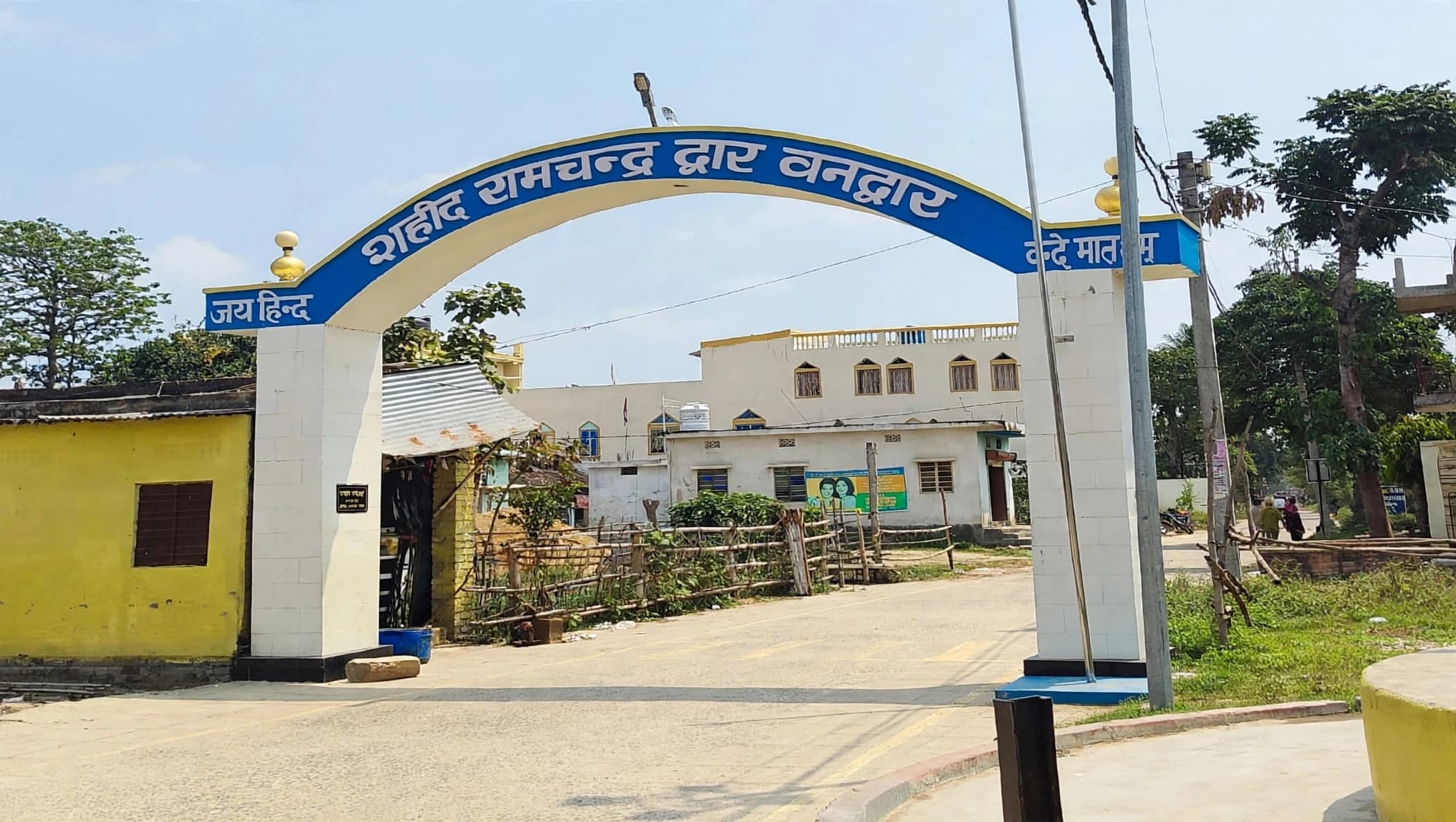
The Shaheed Ramchandra Dwar (Martyrs' Gate) at the entrance of Bandwar village during the day, Begusarai (2026)
View Full Size
Listen to this article

Narrated in English (Browser TTS)

The main entrance gate to Bandwar village, named in memory of Ramchandra ji — a martyr from the village. Built under the initiative of Girija Singh, a resident of Bandwar, the gate stands at the point where the road from Begusarai enters the village. It is inscribed on both sides with 'Jai Hind' and 'Bharat Mata', and has become one of the most recognisable structures in Bandwar.

Overview

Shaheed Ramchandra Dwar is the main entrance gate to Bandwar village. It stands at the point where the road from Begusarai enters the village, and carries the name of a village martyr — Shaheed Ramchandra. The gate is painted blue with white lettering, and is inscribed on both sides with 'Jai Hind' and 'Bharat Mata'. It is the first structure that most visitors to Bandwar see, and it announces the village's identity before they have set foot in it. The Vaani Vilas Pustakalaya stands just behind the gate, on Bandwar Road.

History

The gate was built under the initiative of Girija Singh, a resident of Bandwar, in memory of Ramchandra ji. Its name places it among the 'Shaheed Duars' (martyrs' gates) that are found across Begusarai district — a legacy of the region's history of peasant movements and resistance that earned it the name 'Leningrad of Bihar'. Like the Chandrashekhar Chowk in the village centre, the gate is part of Bandwar's engagement with the wider political and commemorative culture of the district — a way of marking the village's place in a history larger than itself.

Design

The gate is built in the form of a large arch, supported by two pillars. The arch and pillars are painted in blue with white trim, and the pillars are topped with gold-coloured finials. A single lamp is mounted at the top. The simplicity of the design — no ornate carving, no elaborate sculpture — is typical of the memorial gates of the region, which are meant to be functional entrances as much as memorials. The gate is maintained by the village community, and is repainted periodically, especially before major festivals.

Daily Life

The gate is not just a memorial — it is a working part of the village. Every morning and evening, villagers pass through it on their way to work, to the market, or to the fields. During the Janmashtami Mela, the area around the gate becomes a hub of activity, with temporary stalls and vendors setting up under and around the arch. The SBI Bandwar branch, the post office, and other village institutions are all a short walk from the gate.

Present Day

The gate is well-maintained and is one of the most recognisable structures in Bandwar. It has become a landmark that villagers use as a reference point — 'Shaheed Dwar se aage' (beyond the Shaheed Dwar) is a phrase that every resident of Bandwar understands. At night, the lamp mounted at the top of the arch casts a soft light over the road, and the blue-and-white paint of the pillars catches the glow of passing vehicles on the SH 55.

Frequently Asked Questions

Who was Shaheed Ramchandra?
Shaheed Ramchandra was a martyr from Bandwar village, in whose memory the main village gate is named. The gate — Shaheed Ramchandra Dwar — carries his name and is inscribed with 'Jai Hind' and 'Bharat Mata'.
When was Shaheed Ramchandra Dwar built?
The gate was built under the initiative of Girija Singh, a resident of Bandwar, in memory of Ramchandra ji. The exact year of construction is not documented, but the gate has stood for several decades and is periodically repainted by the village community.
Where is Shaheed Ramchandra Dwar located?
The gate stands at the main entrance to Bandwar village, on Bandwar Road — the point where the road from Begusarai enters the village. It is a short walk from the Vaani Vilas Pustakalaya, the SBI Bandwar branch, and the post office.
What is inscribed on the gate?
The gate is inscribed on both sides with 'Jai Hind' and 'Bharat Mata'. It is painted blue with white lettering, with gold-coloured finials on top of its pillars.
Why is the gate important to the village?
The gate is both a memorial and a landmark. It commemorates a village martyr, and it has become a reference point that villagers use to orient themselves — 'Shaheed Dwar se aage' is a phrase every resident understands.

Read Next

Chandrashekhar Chowk: Memorial of Begusarai's First Communist MLA

A village square in Bandwar with a statue of Chandrashekhar Singh — the first communist MLA from Barauni, and a defining figure in Begusarai's identity as 'the Leningrad of Bihar'. The chowk sits at a crossroads in the village centre, and its statue — under a canopy supported by red stone pillars — has become one of the most photographed features of Bandwar.

Historic Well (Chaupal) of Bandwar: The Village Gathering Place

Bandwar's historic well has served as both a source of water and a gathering place — a chaupal — for generations. It was the subject of a feature in Prabhat Khabar in July 2026, which described it as 'still the centre of social dialogue and intellectual discussion in the village'. It sits near [[shivala-temple-bandwar|Shivala]] and the [[chandrashekhar-chowk-bandwar|Chandrashekhar Chowk]], and has been a centre of village life for as long as anyone remembers.

Vaani Vilas Pustakalaya (Village Library)

Vaani Vilas Pustakalaya (वाणी विलास पुस्तकालय) is the historic village library of Bandwar, established in 1945. Its new building, funded by MPLAD and Panchayat, was inaugurated in 2025 by MP Rakesh Sinha, offering Wi-Fi, a seed library, and modern reading spaces.

Bandwar Janmashtami Mela: Bihar's Oldest Fair & Mud-Pit Wrestling

The Bandwar Krishna Janmashtami Mela is a historic fair held annually in Bandwar, running for over two hundred years. Considered the oldest Janmashtami fair in Bihar, it is famous for its traditional mud-pit wrestling (Kushti), drawing wrestlers from across Bihar, Nepal, and beyond. Held at the village ground near the [[historic-well-chaupal-bandwar|chaupal]], the fair is deeply connected to the [[bada-krishna-mandir-bandwar|Bada Krishna Mandir]] and [[chhota-krishna-mandir-bandwar|Chhota Krishna Mandir]].

Burhi Gandak River: Bandwar's Lifeline and Adversary

The Burhi Gandak is a flood-prone river that flows along the western edge of Bandwar, in Begusarai district, Bihar. Situated in the fertile Indo-Gangetic plain, it is the largest tributary of the Ganga in the region. Its annual floods shaped the village's geography, its agriculture, and — most importantly — its name. The embankment built along the river, the [[bandh-embankment-bandwar|bandh]], is widely believed to be the source of the village's name: Bandwar.

Shivala: The Historic Shiva Temple of Bandwar

Shivala is the village's Shiva temple, standing in the centre of Bandwar, Begusarai, Bihar. It is one of the village's eight temples and has served as a place of worship for generations. Built entirely by village residents, without any government support, it stands in a grove of trees near the [[historic-well-chaupal-bandwar|historic well]] that anchors the village centre.

Something is incorrect?

If you have additional details, let us know.

Suggest an Edit
Last updated: 2026-08-15Source: Bandwar Village Archive