Bandwar Village Archive

Ram Katha 2021 at Thakurbari: Ramcharitmanas Recitation in Bandwar

A week of recitation at the village's Ram temple
Verified by Bandwar Editor
| 2026-11-12
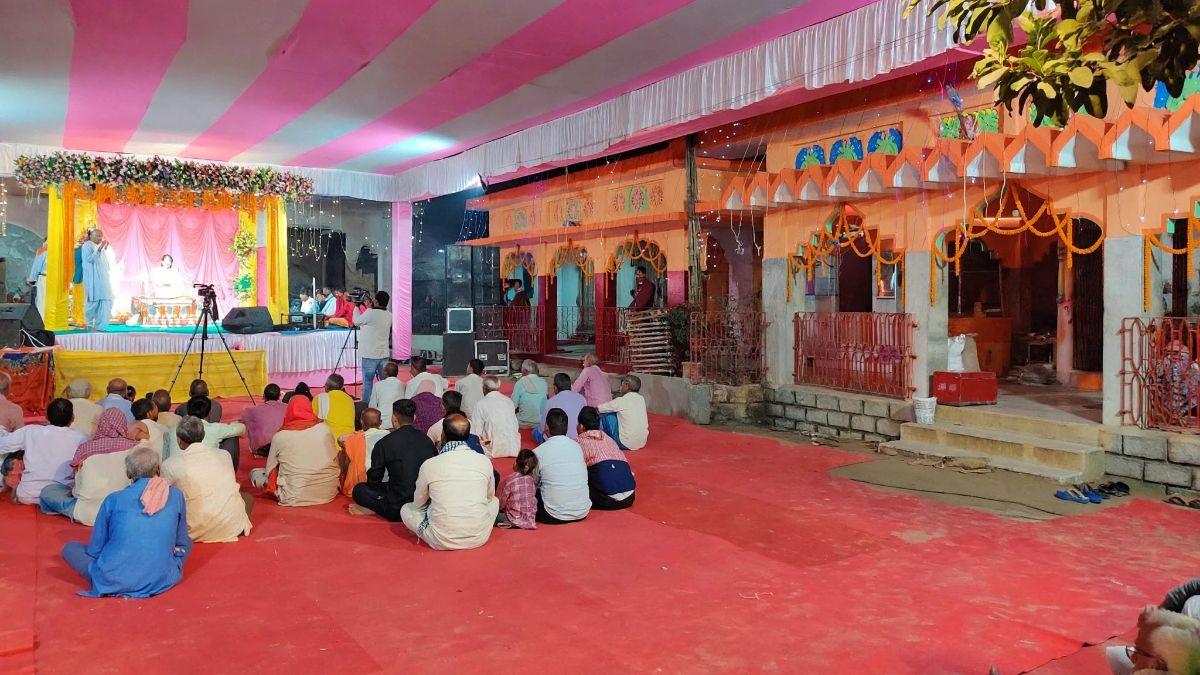
Ram Katha at Ram Mandir Thakurbari, Bandwar, 2021, with villagers gathered under the pink-and-white pandal
View Full Size
Listen to this article

Narrated in English (Browser TTS)

Once a year, the [[ram-mandir-thakurbari-bandwar|Ram Mandir Thakurbari]] hosts a Ram Katha — a multi-day public recitation of the Ramcharitmanas by a trained narrator. The 2021 edition was attended by the entire village, and was held under a pink-and-white striped pandal in the temple courtyard. The Katha is one of the most important religious events in the village calendar, reflecting the deep Vaishnavite tradition of the Mithila region.

Overview

Ram Katha is a multi-day public recitation of the Ramcharitmanas — Tulsidas's 16th-century retelling of the Ramayana in Awadhi — performed by a trained kathavachak (narrator). Once a year, the Ram Mandir Thakurbari in Bandwar hosts one such Katha, and the entire village gathers to listen. Ram Katha is not unique to Bandwar — it is a common practice across North India, especially in the Hindi belt — but the Katha at Thakurbari has particular significance for Bandwar, because the temple where it is held is the village's principal Ram temple.

The 2021 Edition

The most recent publicly documented Ram Katha at Thakurbari was held in 2021. The temple courtyard was covered with a pink-and-white striped pandal, a stage was set up for the kathavachak, and a red carpet was laid across the ground for the audience. Villagers — men, women, and children — sat on the ground through the recitation, listening for hours at a time. The Katha ran for several days, and its sessions were held in the morning and evening, with breaks in between for meals and rest.

The Tradition

Ram Katha has been held at Thakurbari for many years, though the exact number of editions is not documented. The recitation typically covers the seven kandas (books) of the Ramcharitmanas — Bala Kanda, Ayodhya Kanda, Aranya Kanda, Kishkindha Kanda, Sundara Kanda, Lanka Kanda, and Uttara Kanda — over the course of the Katha's duration. The Sundara Kanda, which narrates Hanuman's journey to Lanka, is the most attended session, and it is often scheduled for the evening, when the largest crowd can gather. The Katha's conclusion — the final day, which typically falls on a Sunday — is followed by a hawan (fire ritual) and the distribution of prasad.

The Pandals and Preparation

Preparations for the Katha take several days. A large pandal is erected over the temple courtyard, decorated with flowers and lighting. The villagers contribute to the arrangements — some provide materials, some prepare food, others set up the seating. The festival concludes with a hawan (fire ritual) and the distribution of prasad. The collective nature of the preparations reflects the same community spirit that organises the Janmashtami Mela — no single committee runs the Katha, and every household contributes what it can.

Present Day

The tradition of Ram Katha at Thakurbari continues. The temple's location, in the centre of the village among trees, makes it an ideal venue for such gatherings. The Katha has not been held every year without interruption — there have been years when the Katha was not held, due to various reasons — but it remains one of the village's most important religious events. Villagers who have moved away from Bandwar often return for the Katha, and it is one of the occasions on which the village's diaspora reunites.

Frequently Asked Questions

What is Ram Katha?
Ram Katha is a multi-day public recitation of the Ramcharitmanas — Tulsidas's 16th-century retelling of the Ramayana in Awadhi — performed by a trained narrator (kathavachak). It is a common religious practice across North India.
Where is Ram Katha held in Bandwar?
Ram Katha is held at the Ram Mandir Thakurbari, the village's principal Ram temple, in the centre of Bandwar. A large pandal is set up in the temple courtyard for the recitation.
When was the most recent Ram Katha held?
The most recent publicly documented Ram Katha at Thakurbari was held in 2021. It ran for several days, with sessions in the morning and evening, and was attended by the entire village.
How long does Ram Katha last?
Ram Katha typically runs for 5 to 9 days, covering the seven kandas (books) of the Ramcharitmanas. The Sundara Kanda session — narrating Hanuman's journey to Lanka — is usually the most attended.
Who organises Ram Katha at Thakurbari?
The Katha is organised by the village community of Bandwar. No single committee runs it — villagers contribute materials, food, and labour, and the arrangements are made collectively.

Read Next

Ram Mandir Thakurbari: The Twin-Shikhara Temple of Bandwar

Bandwar's Ram temple, distinguished by its twin shikharas, is one of the most recognisable structures in the village. It is the site of the annual [[ram-katha-thakurbari-bandwar-2021|Ram Katha]] — the recitation of the Ramcharitmanas — and is especially striking against the evening sky at sunset.

Chhath Puja in Bandwar: Celebrating Surya Dev at Burhi Gandak

Chhath Puja is the most significant festival in Bihar and the Mithila region, dedicated to Surya Dev (the Sun God) and Chhathi Maiya. In Bandwar, the festival is celebrated at the [[bandh-embankment-bandwar|bandh]] along the [[burhi-gandak-river-bandwar|Burhi Gandak]], with the entire village gathering on the riverbank. A large idol of Surya Dev, mounted on his chariot with seven horses, is set up at the bandh, and the village observes four days of rigorous fasting and Vedic rituals.

Bandwar Janmashtami Mela: Bihar's Oldest Fair & Mud-Pit Wrestling

The Bandwar Krishna Janmashtami Mela is a historic fair held annually in Bandwar, running for over two hundred years. Considered the oldest Janmashtami fair in Bihar, it is famous for its traditional mud-pit wrestling (Kushti), drawing wrestlers from across Bihar, Nepal, and beyond. Held at the village ground near the [[historic-well-chaupal-bandwar|chaupal]], the fair is deeply connected to the [[bada-krishna-mandir-bandwar|Bada Krishna Mandir]] and [[chhota-krishna-mandir-bandwar|Chhota Krishna Mandir]].

Sankat Mochan Hanuman Mandir: The Hanuman Temple of Bandwar

A temple dedicated to Hanuman ji, known for its bright red idol holding a gada (mace). The temple is small but well-maintained, with a brass bell hung at the entrance. It is one of the eight temples clustered in the centre of Bandwar, and among the most visited.

Shivala: The Historic Shiva Temple of Bandwar

Shivala is the village's Shiva temple, standing in the centre of Bandwar, Begusarai, Bihar. It is one of the village's eight temples and has served as a place of worship for generations. Built entirely by village residents, without any government support, it stands in a grove of trees near the [[historic-well-chaupal-bandwar|historic well]] that anchors the village centre.

Historic Well (Chaupal) of Bandwar: The Village Gathering Place

Bandwar's historic well has served as both a source of water and a gathering place — a chaupal — for generations. It was the subject of a feature in Prabhat Khabar in July 2026, which described it as 'still the centre of social dialogue and intellectual discussion in the village'. It sits near [[shivala-temple-bandwar|Shivala]] and the [[chandrashekhar-chowk-bandwar|Chandrashekhar Chowk]], and has been a centre of village life for as long as anyone remembers.

Something is incorrect?

If you have additional details, let us know.

Suggest an Edit
Last updated: 2026-11-12Source: Bandwar Village Archive